Logo design sits at the intersection of identity, communication, and visual storytelling. It’s one of the most deceptively complex disciplines in design—appearing simple on the surface, yet requiring a deep understanding of form, psychology, typography, and context. A strong logo distills an entire brand into a single, recognizable mark. It must be versatile, memorable, and meaningful—all while working across wildly different applications, from tiny app icons to large-scale signage.
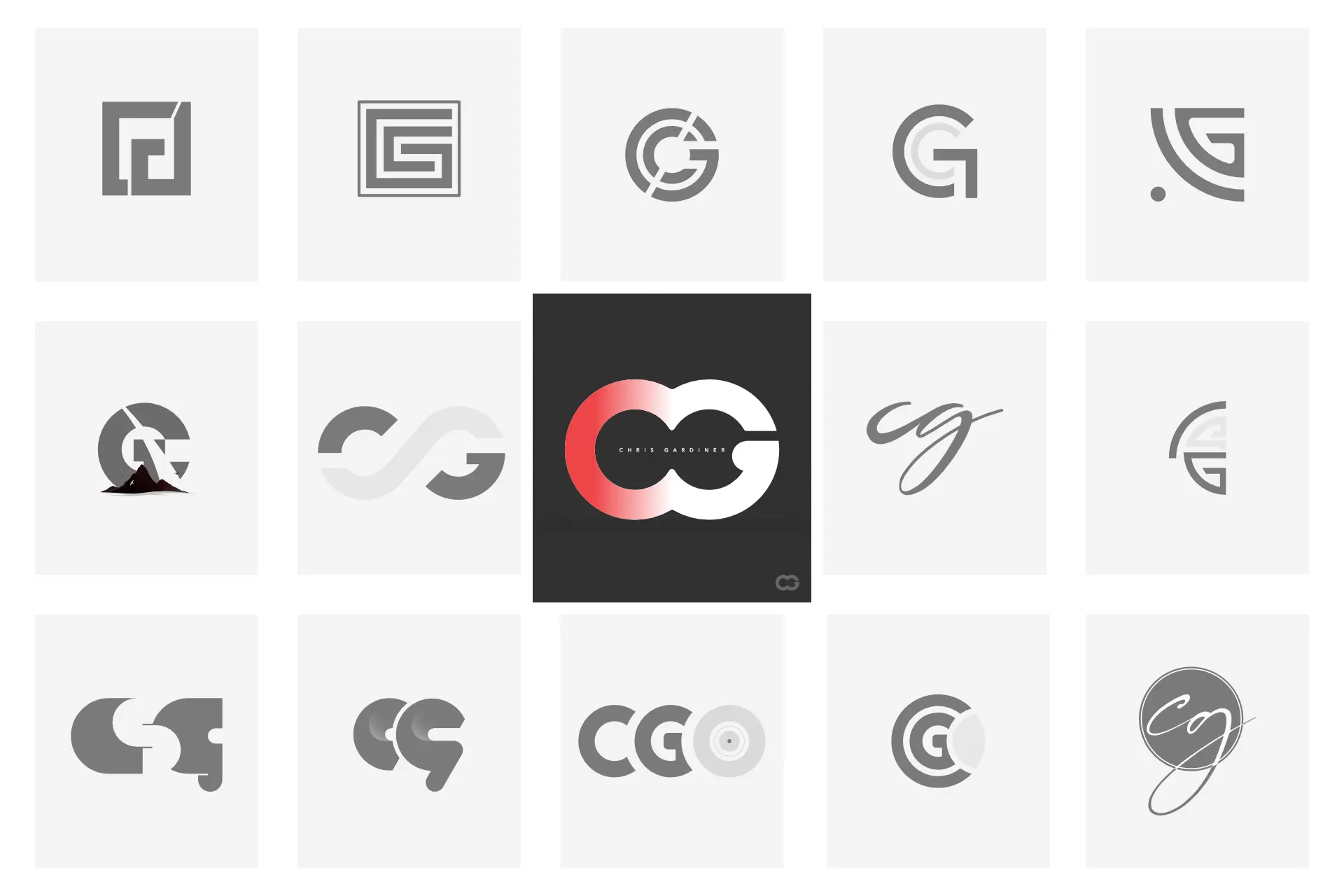
This is an experiment centered around the initials “CG” representing my name (CSG if you include my middle name) - offering a valuable lens into the iterative nature of logo design. Rather than searching for a single “perfect” idea from the outset, this exploration demonstrates how variation, constraint, and repetition can lead to refinement, varieity and discovery. In this article, we’ll unpack the principles behind effective logo design, analyze the creative approaches evident in the CG experiment, and explore what this kind of iterative process teaches us about building strong visual identities.
The Purpose of a Logo: More Than Just a Mark
At its core, a logo is a symbol of recognition. It acts as a visual shorthand for a brand’s values, tone, and personality. Think about how quickly you can recognize a brand from a simple shape or letterform: Nike; BBC, Target, McDonald's; and of course Apple. All iconic yet simple logo designs. That’s the power of a well-designed logo. But recognition alone isn’t enough. A logo must also communicate.
The challenge is that logos operate under constraints. They need to be legible at small sizes, adaptable to different formats, and distinct in crowded visual environments. They must also stand the test of time. Trends come and go, but a logo ideally can remain relevant for years, even decades.
This is where experimentation becomes essential. Rather than settling on the first viable concept, designers often explore a wide range of directions. The CG logo experiment exemplifies this approach by testing multiple visual interpretations of the same two letters (sometimes including S in the mix).
The Power of Initials and Monograms
Designing with initials—like “CG”—is both an opportunity and a challenge.
Monograms have a long history, from royal insignias to modern luxury brands. They offer a compact, elegant way to represent identity, especially when a full brand name might be too long or less visually distinctive.
However, initials also come with limitations. As a designer I must work within the constraints of letterforms that may not naturally fit together. The goal becomes finding harmony between the characters while creating something unique.
In the CG experiment, we see several approaches to this challenge
- Some designs emphasize geometric structure, turning the letters into almost architectural forms.
- Others lean into fluidity, blending the C and G into continuous, flowing shapes.
- A few explore abstraction, where the letters are hinted at rather than explicitly defined.


Each approach reveals a different personality, even though the underlying letters remain the same.
Iteration as a Design Strategy
One of the most valuable lessons from this collection is the importance of iteration. Rather than committing early, I explores multiple visual languages:
Geometric and Structured Forms
Several logos in the grid rely on sharp angles, clean lines, and precise spacing. These designs often feel modern, technical, and controlled. They suggest reliability and clarity—qualities often associated with technology or engineering brands.
Circular and Radial Concepts
Other variations use circular shapes or concentric elements to build the letters. Circles naturally convey unity, continuity, and motion. In the context of CG, they help integrate the two letters into a cohesive whole.
Negative Space Exploration
A few designs cleverly use negative space to define one letter within another. This approach adds a layer of sophistication and invites the viewer to engage more actively with the design. Logos that reveal themselves gradually tend to be more memorable.
Script and Handwritten Styles
Toward the right side of the grid, we see more expressive, handwritten interpretations. These logos feel personal, artistic, and less rigid. They could suit creative professionals or brands that want to emphasize individuality and craft.
Abstract and Experimental Forms
Some designs push the boundaries of legibility, prioritizing visual intrigue over immediate clarity. While these may not work in all contexts, they can be powerful when paired with a strong brand narrative.
The Role of Contrast and Emphasis
The central logo in the collection stands out immediately. While most of the surrounding designs are presented in muted grayscale, this one introduces a bold gradient transitioning from red to white against a dark background. This shift in contrast and color does several things:
- First, it establishes a focal point. Our eyes are naturally drawn to areas of high contrast, and the use of color reinforces this effect.
- Second, it suggests a more refined or “final” direction. While the surrounding logos feel exploratory, the central mark appears more resolved—perhaps representing a chosen direction after experimentation.
- Third, it demonstrates how color can transform perception. The same basic shapes, when rendered in grayscale versus a vibrant gradient, can evoke entirely different emotions.
Typography and Form Integration
When designing with initials, typography becomes both the starting point and the constraint. The CG experiment shows a range of typographic treatments:
- Some designs retain the recognizable structure of standard letterforms, making them immediately legible. Others distort or simplify the letters, prioritizing visual harmony over strict adherence to typographic rules.
- A key challenge here is balance. If the letters are too literal, the logo may feel generic. If they are too abstract, the identity may become unclear. The most successful designs find a middle ground—where the letters are still identifiable but presented in a distinctive way.
- The experiment also highlights how small adjustments can have a big impact. Changes in stroke thickness, spacing, or curvature can completely alter the feel of a logo. This is why iteration is so critical: it allows designers to explore these subtle variations systematically.
Versatility and Application
A strong logo must work across different contexts. This includes:
• Digital interfaces, where the logo may appear as a small icon
• Print materials, where detail and texture can be more prominent
• Large-scale applications like signage or packaging
The CG experiment implicitly tests this versatility. Some designs would scale down well due to their simplicity and bold shapes. Others, with finer details or intricate linework, might struggle at smaller sizes but shine in larger formats.
This raises an important consideration: there is no universally “best” logo. The effectiveness of a design depends on how and where it will be used. A logo for a mobile app has different requirements than one for a luxury fashion brand.
Emotion and Brand Personality
Even without additional context, each logo in the collection conveys a distinct mood. This is one of the most fascinating aspects of logo design: how abstract shapes can evoke specific feelings.
A sharp, angular design might feel precise and professional. A rounded, flowing mark might feel approachable and creative. A minimal, monochrome logo might suggest sophistication and restraint.
In the CG experiment, the diversity of styles demonstrates how a single set of initials can support multiple brand narratives. This is particularly useful in early-stage branding, where the identity is still being defined. By exploring different directions, designers can align visual style with brand strategy.
The Value of Constraints
Working with just two letters might seem limiting, but constraints often fuel creativity. When options are restricted, designers are forced to think more deeply about form, composition, and meaning.
The CG experiment shows how constraints can lead to innovation. By focusing on a fixed set of characters, I explores a wide range of possibilities within a defined space. This kind of focused exploration can be more productive than starting with an open-ended brief.
Constraints also help in decision-making. When evaluating different concepts, I can compare them more directly, since they all share the same fundamental elements.
Refinement and Selection
At some point, experimentation must give way to refinement. The central logo in the collection is the logo I selected to use for this website—a concept that was developed further than the others.
Refinement involves more than just polishing the design. It requires evaluating how well the logo meets the project’s goals. Does it communicate the right message? Is it distinctive enough? Will it work across different applications? Does it fit a website use case?
This stage often involves feedback, testing, and iteration. I this instance, it was all me offering personal feedback.
Even a strong concept may need adjustments to improve clarity or usability. The goal is to arrive at a design that is both visually compelling and functionally effective.
Lessons from the CG Experiment
This collection offers several key takeaways for anyone interested in logo design:
- Iteration is not a sign of uncertainty: it’s a core part of the process. Exploring multiple directions leads to stronger outcomes.
- Small changes matter. Adjustments in spacing, proportion, and alignment can significantly impact the final design.
- There is no single “correct” solution. Different approaches can all be valid, depending on the brand context.
- Contrast and emphasis guide attention. Strategic use of color and composition can highlight the most important elements.
- Constraints can enhance creativity. Limiting the design space often leads to more thoughtful and innovative solutions.
My Final Thoughts: Designing Through Exploration
Logo design is rarely a linear process. It involves cycles of exploration, evaluation, and refinement. The CG logo experiment captures this dynamic beautifully, showing how a simple idea—two letters—can evolve into a wide range of visual expressions.
What makes this approach effective is its openness. Instead of rushing toward a final answer, I allow space for discovery. Each variation contributes to a deeper understanding of the problem, even if it doesn’t become the final solution.
In the end, a great logo is not just the result of a single idea, but the culmination of many. It reflects the choices made along the way—the directions explored, the ideas discarded, and the insights gained through iteration.
The CG experiment serves as a reminder that design is as much about the journey as the destination. By embracing experimentation and staying curious, designers can uncover solutions that are not only functional, but also meaningful and memorable.
I would be interested to know what your thoughts are, and what logo option(s) you prefer?

